For anyone interested in Japan. Written in both English and easy Japanese. Forgive me if I make too many English mistakes!
Showing posts with label Japanese bread I want to recommend. Show all posts
May 21, 2013
Japanese bread that I want to recommend ③: kare-pan (curry pain) & Melon-pan
If you like curry, I'm sure you'll love カレーパン(curry pan) as well (photo above).
Needless to say, "pan" comes from a Portuguese word for bread. Curry-pan, pronounced karee-pan in Japanese, is a bun stuffed with curry paste. As it is deep-fried like a donut, it is sometimes called カレー・ド-ナッツ (karee-donattsu, curry donuts), but it rather reminds me of Russian snacks pirozhki.
As curry-pan uses no ingredients that are too "interesting"or "exotic" to non-Asians, I think everyone can eat it without hesitation. If you are not allowed to eat pork for the religious reasons, however, you'd better check with someone at the bakery before buying one. You can ask this way: ぶたにくは はいっていますか。 (Buta-niku wa haitte imasuka? Does this contain pork?)
We don't know exactly who "invented" the curry-pan, but it is generally believed that some bakers or restaurant cooks started making it in the early 20th century, when Japanese were becoming familiar with foreign food. Today it is available at almost any bakeries.
The photo above is a melon-pan, a different type of bread that I want to show you.
Melon-pan is a sweet fluffy bun covered with crisp cookie dough. It is called this way because they say it looks like a melon. Ummm... I have never thought it looks like a melon, though.
What about taste? Does it taste like a melon? In recent years, some manufacturers are making melon-flavored melon-pan, but traditionally we add nothing that tastes or smells like a melon to the dough.
Melon pan was believed to have first created in Japan in the beginning of the 20th century, around the World War I. Ever since, they have been popular not only in Japan but also in Taiwan and China. Today, there are even stores specializing in melon-pan, where you can find many different flavors such as chocolate, caramel, orange and strawberry.
Ah, there's one thing I have to say. One melon-pan is about 500 kcal. If you don't want to get fat, don't eat it too much!
May 10, 2013
Japanese bread that I want to recommend ②:anpan
Have you seen a Japanese TV cartoon series "Soreike! Anpanman (Go! Anpanman)"? Anpanman is probably the most popular fictional character among small children in Japan. As his indicates, he is a super hero who has a head of あんぱん(ampan), a sweet bun filled with sweetened bean paste called あんこ (anko).
Here is the image that I found in the official website .
A true anpan looks like this. This is the anpan I bought the other day at my neighboring bakery.
I cut it in two to show you the inside...
Unfortunately many Westerners don't like anko so much, but if you like Chinese sweets using same type of bean paste, I'm sure you'll like anpan as well.
Anpan was "invented" in 1874 by a former samurai/first Japanese baker Yasubei Kimura, and spread all over the country. It is now available everywhere and loved by people of all generations.
Kimura's shop, called Kimuraya, still exists in the classy shopping district Ginza (4-5-7 Ginza, Chuo-ku, Tokyo. tel: 3561-0091 ), close to the Ginza-Yonchome Crossing. You can buy their delicious anpan on the first floor, and there are a cafe and restaurants on the upper floors of the building.
Today's useful expression: あんぱん ひとつ ください。 Anpan hitotsu kudasai.
Please give me an anpan.
Here is the image that I found in the official website .
He flies in the sky and beats evils, like Superman, but this Japanese cartoon character may be even more heroic than the American counterpart in a way. He is amazingly selfless, and when he sees starving people he offers them his bread head!! Don't worry, he will not die but just lose some of his physical strength, and Uncle Jam the baker will repair his head later. Very strange, but kids take it as a matter of course.
A true anpan looks like this. This is the anpan I bought the other day at my neighboring bakery.
I cut it in two to show you the inside...
Unfortunately many Westerners don't like anko so much, but if you like Chinese sweets using same type of bean paste, I'm sure you'll like anpan as well.
Anpan was "invented" in 1874 by a former samurai/first Japanese baker Yasubei Kimura, and spread all over the country. It is now available everywhere and loved by people of all generations.
Kimura's shop, called Kimuraya, still exists in the classy shopping district Ginza (4-5-7 Ginza, Chuo-ku, Tokyo. tel: 3561-0091 ), close to the Ginza-Yonchome Crossing. You can buy their delicious anpan on the first floor, and there are a cafe and restaurants on the upper floors of the building.
Today's useful expression: あんぱん ひとつ ください。 Anpan hitotsu kudasai.
Please give me an anpan.
May 9, 2013
Japanese bread that I want to recommend ①: shokupan
My former British student told me once that she was having trouble finding hard brown bread here. That's true. The types of bread available at most bakeries in Japan are different from what Western people are eating in their home countries. I cannot say which tastes better, Japanese or Western. It is just different, and I like both.
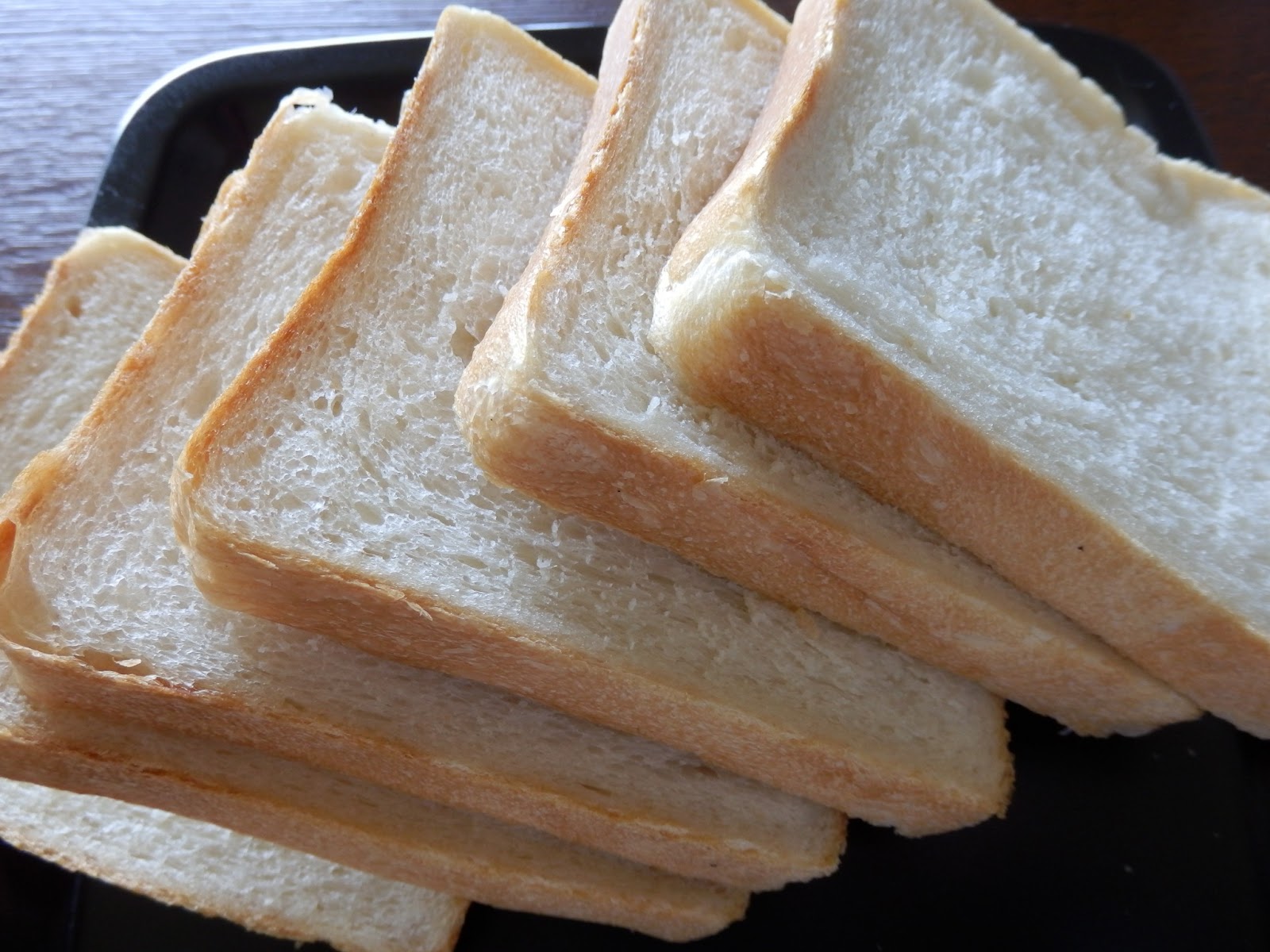
When I was living in Paris, I really loved all types of French bread -- baguettes, croissants and pain au raisin, etc. -- but I sometimes felt like eating softer, sweeter, fluffy Japanese bread. What I missed most was "shokupan," a loaf of simple white bread similar to pain de mie, but bigger and much softer.
It may look like ordinary white bread that you can find anywhere in the world, but...
When I picked up a piece with fingers, it slightly droops due to its softness.
Some people prefer eating "shokupan" with no butter, no jam, even untoasted, so that they can fully enjoy its fluffy texture and subtle sweetness. I can understand them, but I usually toast it lightly, which makes the outside crispy but keeps the inside soft. Ah, it is so yummy.
If you would like to know what a thick and soft Japanese toast tastes like, you should try a "morning set," which normally includes a thick toasted shokupan slice, a boiled egg or a sunny side-up, a drink and sometimes salad. You can order it at many 喫茶店(kissaten) or coffeehouses.
The photo below is a morning set menu offered at 上島珈琲店 Ueshima kohi-ten, a popular café chain located mainly in Tokyo area. Look how thick the bread is! Be careful, the morning set is available only in the morning, till 11 a.m. at Ueshima.
When you buy a loaf of shokupan at a bakery, you can ask them to slice it. If a regular size of loaf is sliced in six, one piece is about 2cm thick.
Today's useful expression: 6まいに きってください。 Rokumai ni kitte kudasai. (Please slice it in six. )
You can replace rokumai (six slices) with the number you like, such as yonmai (four), gomai (five), rokumai (six), jumai (ten) .
*If you have any questions, don't hesitate to email me. Also, I'd appreciated if you correct my English errors. Thank you!
Subscribe to:
Posts (Atom)