Showing posts with label machine terms. Show all posts

Apr 30, 2013

How to flush a toilet...NEVER press an emergency button!!

Hi everyone!

When I came back to Japan from France after living for three years, I was so sad to think that I could no longer walk along the Seine, enjoying picture-like views. I had a lot of great memories in Paris, but there were things that made me feel relieved to be back. One of such things is public restrooms.

In Paris, filthy wet toilets were very common and I was often so reluctant to use them, whereas  public restrooms in Japan are generally clean (of course there are exceptions) and I sometimes think I could even live in there.

Today's topic is how to flush toilets in public places such as restaurants, stations and department stores. As Japanese toilets are becoming more and more high-tech, you may feel confused, not knowing how to flush.

This is a very simple flush button.  流す (ながす、nagasu) means to flush. You only have to press it.


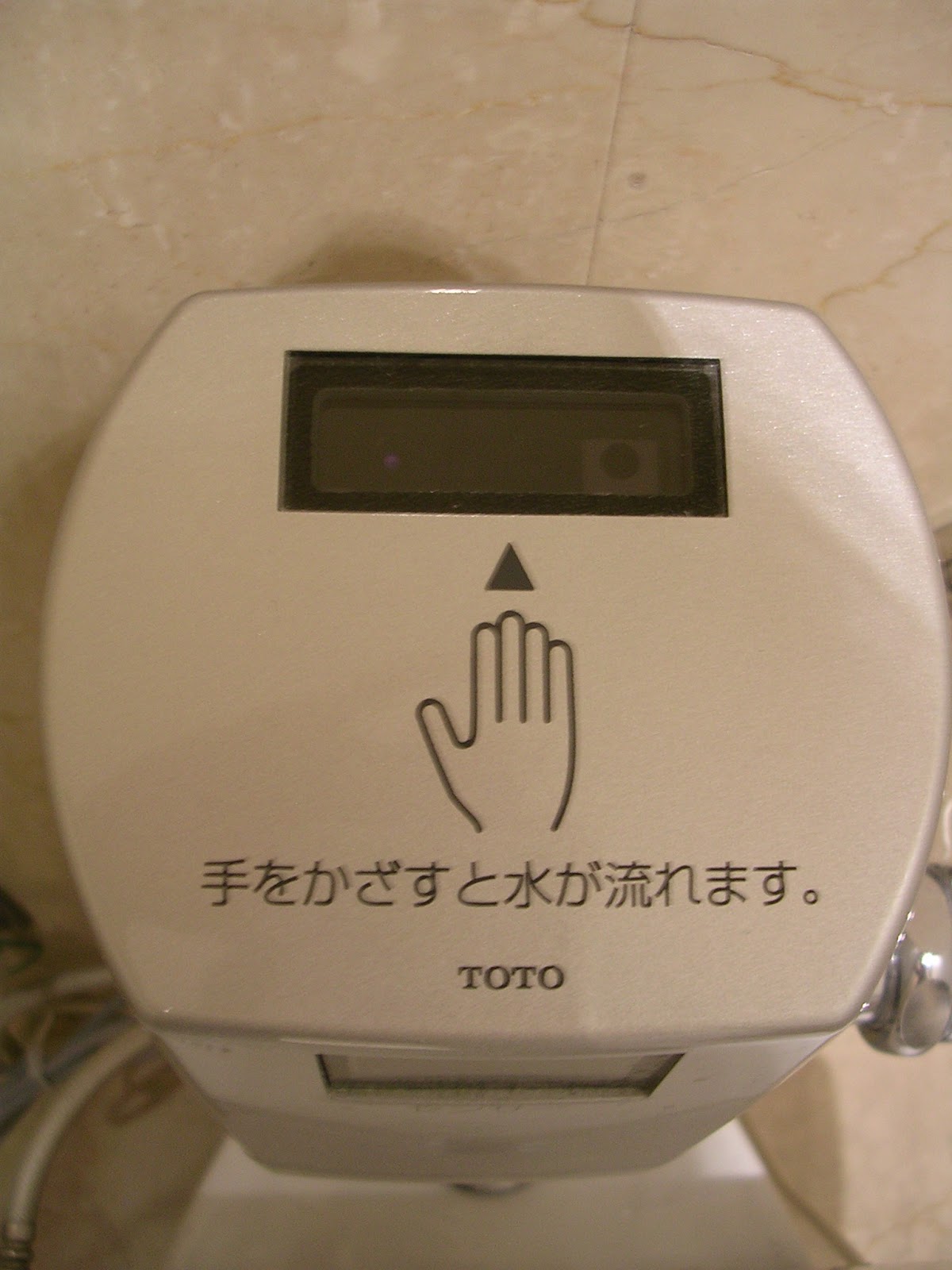
The photo below is a sensor-operation type. Place your palm over the sensor, and the toilet will flush.


Sometimes it is difficult to find a flush button, but don't panic. If you find a Washlet control panel installed on the wall, flush buttons must be somewhere on the panel, normally on its upper part. You can't see them from this angle, but...


Look! Can you see two “流す (to flush)” buttons? After peeing, press the right one marked with a Chinese character , which literally means "small" but in this case "urine".  When you need more water to clean the toilet, press the left one. In this photo nothing is written on this button, but you can often find a different character (lit. big) on it. I don't have to explain what it means, do I?


Automatic flush toilets are also becoming very common. When you leave the toilet, the toilet automatically flushes, but what should you do if you want to flush more than once? Look for a sensor panel like the one below, and press a manual operation button 手動ボタン(しゅどうボタン, shudo botan). In this photo it is the round white buttan with a red dot in the middle.


One more thing... it is safer NOT to touch anything red in the bathroom stall, whether a button or a cord. It is most probably an emergency button. Several years ago one of my former students (I'm a Japanese teacher) mistakenly pressed an emergency button at a railway station, trying to flush the toilet. Panicked, she ran away before station staff arrived to rescue her!

OK, here's today's useful expression: すみません、水が流れません。 Sumimasen, mizu ga nagaremasen. (=Excuse me, the toilet won't flush. )

I don't want to imagine the situation you have to use this phrase, though...

Apr 24, 2013

The Washlet terms: how to use a modern bidet toilet

Hi everyone!

If you live in Japan, I guess you have already used Washlet, or a modern toilet seat with bidet functions, and know well how to use it.

So this post is for someone who just arrived in Japan or those planning to visit here.

"Washlet" is actually a brand name of Toto Ltd. but everyone commonly calls this type of toilets Washlet, like Band-aid or Stotch Tape, no matter which company produces it. 

I heard that a Washlet is installed in over 70 percent of Japanese households today. It is very common in public places as well, such as hotels, stations, restaurants and department stores.

OK, this is the one I'm using at home. It is not the latest model, but has all basic functions.


When you want to wash the anus, press the おしり (oshiri, or bottom) button, the second from the left. A nozzle comes out from underneath the toilet seat and squirts warm water. If girls would like to clean the different body part, press ビデ (bide, or bidet) button next to it, and the angle of the water jet will change.

To stop the water, press the left-most orange button marked  (stop). Don't forget. Never stand up before turning off the water, or the toilet floor gets wet.

After that you can dry the washed area with a blow dryer by pressing 乾燥(かんそう kanso, dry)button. However, I would recommend you the "conventional toilet paper method" because it takes long enough to dry the bottom completely and you might get cold.

You can adjust the strength of the water jet with the right-most 水勢 lever. Turn it clockwise (toward meaning strong) to have more powerful jet, and rotate in the opposite direction (toward or weak) when you want it softer. Be careful, if the jet is too strong, some water gets into your body and makes you jump!

Today's useful Japanese expression:
トイレ は どこ ですか。Toire wa doko desuka?  Where is the toilet (bath room)?
or  more politely
おてあらい は どちら ですか。 Otearai wa dochira desuka?
Oteawai literally means the place to wash the hands.  


Apr 8, 2013

air conditioner remote

Hi everyone.

I chose this topic  for my first blog post, because you cannot survive the obnoxiously hot and humid Japanese summer without air conditioner.

You think it is a bit too early to use an air conditioner? Well, maybe. But you'll use it sooner or later. Look at your remote. You'll find mostly kanji (Chinese characters) and some hiragana or katakana on it. 

Learn to decipher the air conditioner terms now and get yourself ready, so that you can avoid the risk of pressing the  "暖房(heating)" button on a steamy hot day.


運転 : turn on
停止 : turn off
冷房 : cool mode
暖房 : heater mode
送風 : fan only
ドライ : dry mode

温度 : temperature
風量 : fan volume
風向 : fan direction
入タイマー : power ON timer
切タイマー : power OFF timer
取消 : cancellation