Showing posts with label food. Show all posts

Sep 15, 2013

The season of sweet potatoes has come!

Hi everyone. This summer was hotter and longer than ever, but since last week the temperature has gradually begun to drop and we can sleep without air conditioning these days.  Ah, finally!!

Yesterday I really felt that autumn has come when I found beautiful satsuma-imo (sweet potatoes) sold at a nearby vegetable store. The vivid red skin tinged with purple drew attention of many shoppers, including myself, and I could not pass by without getting one bag.
 
Look what I got. It is Beniazauma, a kind of sweet potato produced mainly in the Kanto area, and very sweet and tasty.
  

Satsuma-imo is a plant native to South America and is believed to be brought to Japan via China in the 17th century. Easy to grow, it was encouraged to cultivate as a counterpart against famine. Nowadays, it is grown in many parts of the country, but as the name indicates (Satsuma is the ancient name of Kagoshima Prefecture, and imo is potatoes), about 40 percent of satsuma-imo cropped in Japan is from Kagoshima, southernmost area of Kyushu Island.

There are so many types of sweets using satsuma-imo, and I'll introduce you some goodies that I recently ate. 

At this time of year many bakeries start baking their original bread and pastry with this seasonal ingredient, like the photo below. This is "Naruto Kintoki Bread," containing diced naruto-kintoki (a kind of sweet potato) grown in Naruto, Tokushima Prefecture. Natural sweetness of the satsuma-imo goes very well with the fluffy bread sprinkled with sesames. I really liked it!

When I think of sweets using sweet potato, what comes uppermost is this "imo-yokan" of Funawa, old confectioner established in 1905 in Asakusa, Tokyo. I've had it so many times and I always find it good.


The making process is very simple. It includes mushing steamed satsuma-imo, adding sugar and a little bit of salt, mixing it well, putting it in a square mold and chill it. That's all! No synthetic additives such as artificial colors and preservatives are used.

You can easily imagine what it tastes like, can't you? Nothing surprising, but if you like sweet potatoes, it will never disappoint you. Actually, its simple flavor has been long loved by people of all generations. Available at major department stores and airports, not only in autumn but throughout the year.

At last I'll show you my favorite snack food "imo-kenpi," candied strips of satsuma-imo. I have loved it since I was a small child. You can buy it almost anywhere for only  100-200 yen for a bag. In the photo below, they may look like McDonald's french fries, but actually it is totally different. Coated with sugar, imo-kenpi is very hard, crunchy and addictive. Once I start eating, I can never stop, knowing it is relatively high in calories (sigh...).


If you feel like making some goodies at home, I'll recommend you daigaku-imo, literally meaning university potatoes. I heard that this snack goes by this strange name because it was very popular among university students in Tokyo when it was invented in the Taisho Era (1912-1926).  Here's the youtube video that shows how to make it. Enjoy!


 ここからは日本語で。
From here I'll write in Japanese for Japanese learners.

日本はようやく秋らしくなってきました。秋と言えば、サツマイモ。先日近くの店でサツマイモが売られているのを見ました。

日本  にほん Japan
ようやく  finally
秋 あき  autumn
先日 せんじつ  the other day
近く  ちかく nearby

早速買って食べてみましたよ!私が買ったのは関東地方でよく採れるベニアズマという品種。小さいのですが、甘くておいしいです。

早速  さっそく immediately
関東地方  かんとうちよう  Kanto area
採れる  とれる  can be cropped
品種  ひんしゅ  kind
甘い  あまい  sweet

サツマイモを使った料理はたくさんあるのですが、今日は最近私が食べたものをいくつかご紹介します。

最近  さいきん recently
いくつか some
紹介  しょうかい to introduce


まずは「鳴門金時ブレッド」。角切りの鳴門金時(徳島県で取れるサツマイモ)がたくさん入っているパンです。とてもおいしかったですよ。

まず first of all
鳴門金時 なるときんとき kind of sweet potato 
ブレッド  bread
角切り  かくぎり  diced
徳島県  とくしまけん  Tokushima Prefecture
パン  bread

それから、舟和のいもようかん。いもをふかして、つぶして、砂糖と塩を混ぜて、型に入れて固めた素朴なお菓子です。昔からよく食べていました。

舟和  ふなわ  name of the confectioner
ようかん a kind of Japanese dessert
ふかす  to steam
つぶす  to mush
砂糖  さとう  sugar
塩  しお  sult
混ぜる  まぜる  to mix
型  かた  mold
固める  かためる   make it firm
素朴  そぼく  simple
昔  むかし  long time ago

最後にいもけんぴ。細く切ったサツマイモを油で揚げてから砂糖で表面をコーティングしたお菓子です。子供のころから私が大好きなお菓子です。スーパーやコンビニで買うことができます。値段は一袋100~200円。フライドポテトみたいに見えますが、もっと固くて、カリカリしています。一度食べたら、止まらない!

最後  さいご  at last
細く切る  ほそく きる to cut into thin and long strips
油  あぶら  oil
揚げる  あげる to deep fry
表面  ひょうめん  surface
コーティング  to coat
子供  こども  child
お菓子  おかし sweet
スーパー  supermarket
コンビニ convenience store
値段  ねだん  price
一袋  ひとふくろ  a bag
固い  かたい  hard
カリカリ  crispy

もしサツマイモを使ったお菓子をうちで作ってみたかったら、「大学いも」はどうですか?簡単に作れておいしいですよ。作り方はYouTubeでチェックしてね。

大学  だいがく  university
簡単に  かんたんに  easily
作り方  つくりかた  how to make

Aug 2, 2013

Edamame beans are the best nibbles to go with beer!

Hi everyone! Sorry I haven't posted for weeks. Are there still someone interested in my blog?

From now on I'll write this blog both in English (probably full of mistakes though) and my native language Japanese. As you can see in my profile, I'm a Japanese teacher and I suddenly felt like doing something a little more beneficial for those studying Japanese.

The Japanese text probably intermediate and advanced level. 

これから日本語を勉強している人のために、日本語でも書きますよ。私、日本語の先生なので。レベルは中級から上級なので、ちょっと難しいかも。

Today's topic is "edamame," young green soybeans usually served in the pod. It is the ever-popular appetizer that goes very well with beer. When we sit at a the table of an "izakaya,"  a type of Japanese eating establishment that serves a great variety of foods as well as alcohol (and non-alcohol) beverages, many of us half-unconsciously order a jug of beer and edamame.
 

I suppose that edamame is now eaten not only in East Asia but also in some Western countries where Japanese foods are accepted. For example, when I was living in Paris, I often bought edamame at Picard, French frozen food store chain, and I found their made-in-Thailand edamame very delicious, probably even better than average Japanese edamame beans.

Frozen edamame is available all year around, but you should buy fresh ones in summer, found at any supermarkets and vegetable stores. This time I bought the ones still attached to the branches. It was 390 yen at a nearby store, a bit more expensive than the average price for edamame.  


This is how it looks when you remove the plastic bag. I can tell it is still very fresh from the look of the leaves. Not bad at all.
  

Cut off the pods from the branch with scissors. It would be better to cut off one or both ends of the pods, so that the salted water comes in the pods when boiling them.
Like this...oops! Sorry the photo is blurry (again). I cannot blame for these bad photos on my camera, because it is new..


Wash edamame beans with running water, and then rub the pods with about 10 grams of salt to remove fine hair covering the surface. Don't rinse after that.


Boil 1 liter of water and add 40 grams of salt. Put edamame in it and cook 5-7 minutes. Be careful not to overcook to keep the texture.
 
Drain edamame in a colander and cool it as quickly as possible to keep the green vivid color. In this photo, I'm fanning edamame with a ”sensu” (folding fan). Looks strange, but I don't have ”uchiwa” (round flat paper fan). Taste one and if it is not salty enough, sprinkle salt over edamame.


Edamame is not only tasty but rich in dietary fiber, protein, iron, magnesium, vitamin K, etc. In short, it is good for your health.

Pods are not edible. Push the beans out of the pod with your fingers and pop them into your month. Enjoy!!


Today's useful expression or tourists. At izakaya,
「とりえず、なま(ビール)の ちゅうジョッキ と えだまめ ください。」
"Toriaezu nama no chujokki to edamame kudasai."
= First of all, one draft beer in middle-sized jug and edamae, please."
chu-jokki (middle size) is most common here for some reason. Beer is a beverage
**********************************
From here, I'll write in Japanese. ここからは日本語で。

今日のトピックは枝豆です。枝豆は未成熟大豆で、日本ではビールのおつまみの定番です。居酒屋では多くの日本人が枝豆をたのみます。生ビールもね。

枝豆:えだまめ
未成熟:みせいじゅく immature
大豆: だいず soybeans
定番: ていばん must-have items
居酒屋: いざかや


多分今は日本だけでなく、他の国でも枝豆を食べていると思います。フランスの冷凍食品店のピカールでも冷凍の枝豆が売っていて、私はパリに住んでいるときによく食べていました。タイ産でしたが、とてもおいしかったですよ。日本のよりもおいしいかも。

多分:たぶん
冷凍食品:れいとうしょくひん frozen food

日本にも冷凍枝豆はありますが、夏は八百屋やスーパーに新鮮なものが出ますから、それを買いましょう。 今回私は枝付きのものを買ってみました。 近くの店で390円。

八百屋: やおや 
新鮮: しんせん fresh
今回: こんかい this time
枝付き: えだつき with branches

ビニール袋を取ると・・・こんな感じ。の感じを見ると、新しそう。よかった。

ビニール袋: ビニールぶくろ a plastic bag
葉: は leaves
 
はさみで豆を枝から切り離します。このとき、を少し切ると、塩茹でしたときに味が良くしみます。写真がぼけていて、すみません。

離す: はなす to detach
鞘: さや pod
端: はし end
塩茹で: しおゆで to boil in salted water
ぼける: out of focus, blurry

枝豆を洗ったら、振ってもみます。枝豆の表面細い毛を取るためです。この後、水で洗い流さないほうがいいです。

塩:しお salt
振る: ふる sprinkle
もむ: to rub
表面: ひょうめん surface
細い: ほそい fine
洗い流す: あらいながす to rinse

沸かして、塩を加え、5-7分枝豆を茹でます。茹ですぎると歯ごたえがなくなから、注意して!

湯: ゆ hot water
沸かす: わかす to boil
加える: くわえる to add
茹でる: ゆでる to cook in boiled water
歯ごたえ: はごたえ texture
注意: ちゅうい attention


茹でたら、すばやく冷やします。 私は、「うちわ」がないので、扇子であおいでいます。
すばやく: quickly
扇子: せんす folding fan

枝豆はおいしいだけじゃなくて、食物繊維たんぱく質、マグネシウム、ビタミンKが豊富です。要するに体に良いってこと。

食物繊維:しょくもつせんい dietary fiber
たんぱく質: たんぱくしつ protein
鉄:てつ iron
豊富: ほうふ rich

食べるときはで鞘を押してを口の中に放り込みます。鞘は食べられませんよ!
指:ゆび fingers
押す: おす to push
豆: まめ beans
放り込む: ほうりこむ to pop something into~


Jun 27, 2013

Unagi (freshwater eel) is endangered! Eat it now!!

I wrote about a conger eel bowl (穴子丼 anago-don) some time ago. As I already mentioned there, there is another snake-like animal that looks very similar to anago. Yes, it is うなぎ (unagi, freshwater Japanese eel)! Look at the photo below that I found in the website of Shzuoka Unagi Fishermen's Cooperative.


If you have ophidiophobia, this photo might make you feel like vomiting. Well, I admit that these slimy creatures look grotesque, but they taste very good once cooked. Rich in vitamin A and E and omega-3 fatty acids, unagi has been traditionally eaten especially in summer when people feel tired and need to gain stamina.

Unlike other types of fish, unagi is very hard to prepare at home. It is almost impossible for non-professionals to split down the back or the belly (depending where you live) of this long slimy fish, which requires special techniques. So we usually eat unagi at restaurants or buy already-cooked one at fish shops or supermarkets.


This is うな重 (unaju) that I had recently, for the first time in a year. The one served in lacquered bento-box like this is called unaju, and the one served in a bowl is called うな丼 (unadon), both of which are basically the same -- broiled unagi fillets on top of steamed white rice.

Eels are most commonly eaten in 蒲焼(kabayaki,) style like this photo, where the fish is grilled or broiled after being dipping in soy-based sweet sauce called たれ(tare). When it is cooked without this sauce, it is called 白焼き(shirayaki), which is also very delicious

I really love unagi, but unfortunately I have not had it much since last year, because the price of unagi is now rocket high. Catches of Japanese eel fry (しらすうなぎ shirasu unagi) have been increasingly poor these last couple of years due to overfishing and climate changes. Last year the Ministry of Environment designated Japanese eel as the species at the risk of extinction. If this situation continues, we will not be able to eat eels in the near future. 

It is known that Japanese eels spawn in the Pacific Ocean, somewhere near Guam, and the young eels migrate to Japanese rivers. Unagi fishermen catch them at the mouth of the rivers and make them grow big at the farms. The problem is, hatching of fertilized eggs at laboratories is quite difficult, and growing the newly-hatched eels bigger is even more difficult and pricey.  

Eels are not the type of fish we eat every week, yet I'd like to have it at least once a year. I would be really sad if eel fishing is completely banned. If you have a chance to come to Japan soon, try to eat eels before they become extinct!

Today's useful expressions: 今日のお昼は、うなぎを食べようよ。Kyo no ohiru wa unagi o tabeyoyo. = Why don't we eat eels for today's lunch?

Jun 11, 2013

My favorite desserts available at コンビニ(convenience stores) in Japan

A convenience store is a small store that sells various everyday items, ranging from foods to toiletries. I'm sure similar stores are everywhere in the world, but for many Japanese, コンビニ, pronounced konbini, is not a substitute for a supermarket.

First of all, konbini is truly convenient. No exaggeration. Other than getting foods and drinks, we can pay utility bills, withdraw money from ATMs, make photocopies, send fax, receive concert tickets, ship parcels, etc. at konbini of all over the country.

Konbini is sometimes more useful than big supermarkets dealing with a great variety of items, especially when you buy only a few things, such as onigiri (rice balls) and a bottled tea. As people usually buy only a few things at a time, you don't have to wait long in a queue for payment.

Above all, we love  convenience stores. Many of us feel like stopping at a konbini for no special reasons on the way back home. We go inside and browse magazines for a while and get some drinks, desserts or hot snacks before leaving. This little ritual helps us relax and change our mood.

They constantly change the selection of goods, and develop their "original" products, so that we can find something new whenever we drop in. It is so much fun!

I often go to a 7-Eleven to buy desserts, not because I prefer this chain to others, but because it is the closest to my place. The photos below are the ones I get pretty often these days.


This is the a cake roll called "Shifuku no Roll Cake (Ultimate Roll Cake)" using super-soft whipped fresh cream from Hokkaido. 150 yen.  


A cream puff filled with very smooth custard. 105 yen. Very reasonable price and always delicious! One thing you should remember: a cream puff is called シュークリーム (shu kurimu) in Japanese, the same pronunciation as shoe cream. Shu kurimu comes from a French word chou à la crème. When you are looking for "shoe cream,"  you have to ask "くつずみ は どこですか?(Kutsuzumi wa doko desuka?)," not "Shu kurumu wa doko desuka"?


This is my favorite Creamy Mont Blanc topped with pureed Italian chestnut. Very tasty. 250 yen.
If you remove the plastic dome lid... 


See? Isn't it beautiful? Very creamy whipped cream inside. You can buy small happiness for only 250 yen! 

At 7-Eleven, new items developed by the special teams of the headquarters come out every Tuesday. They include onigiri (rice ball)  with new fillings, bento boxes, sandwiches, desserts, bread and more.

If you have a chance to visit Japan, try to check out Japanese konbini! 

May 16, 2013

How to order sushi ②: tuna


Hi everyone!

Look at the photo above! The red sushi on the right is, needless to say, tuna, more exactly fatty tuna. Doesn't it look delicious? Well, it was VERY tasty.

Tuna is obviously the most popular sushi topping among Japanese. That's why I decided to pick up tuna as the first topic in this sushi series. 

Tuna fish is generally translated "maguro" in Japanese, but at sushi restaurants maguro usually means "lean tuna,"  and fatty portion of tuna belly is called by different name, "chu-toro" or "o-toro" depending on how fatty it is. (O-toro is fattier than chu-toro) .

When it comes to the price, the fattier, the more expensive. According to the price list of Bikkuri-zushi, a popular sushi chain in Tokyo and Kanagawa Prefecture, a maguro is 157 yen, a chu-toro is 262 yen and an o-toro is 420 yen.  (Be careful: sushi usually comes in two pieces, but this price is for only one piece.)

I know many foreigners prefer lean tuna, but you have to try chu-toro at least once. You'll be surprised at its soft melting texture!! I personally find chu-toro best among three kinds: maguro, chu-toro and o-toro. 

Today's useful expression: 中トロ、おねがいします Chu-toro onegaishimasu, Chu-toro please.  
You can replace chu-toro with whatever you'd like to eat.

Apr 25, 2013

Which tofu to choose? Cotton or silk?

Hi everyone!

Today's topic is tofu. I guess I don't have to explain what tofu is. But do you know the difference between "cotton tofu" and "silk tofu"? Or you haven't even noticed that there is a variety in tofu?

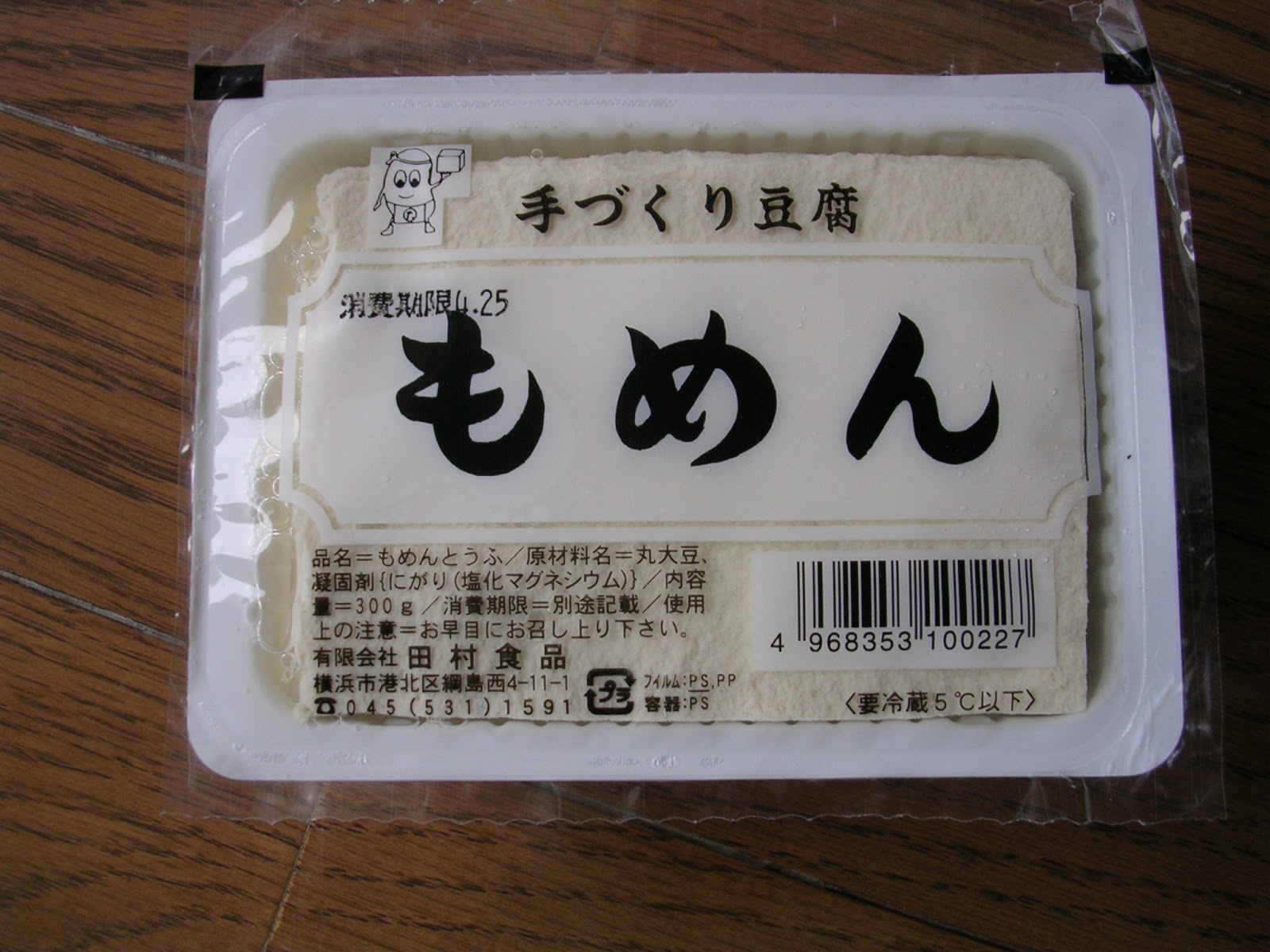
Well, this is a soft silken tofu, called 絹豆腐きぬどうふ、 kinu-dofu, silk tofu) or 絹ごし豆腐きぬごしどうふ、kinugoshi-dofu, literally meaning silk-filtered tofu) in Japanese. Can you see the hiragana “きぬ”?


The name comes from the very soft, smooth texture. A silk filter is not used to strain soy milk in the manufacturing process, as some people misunderstand. Silken tofu is much more delicate than a firm tofu, also called 木綿豆腐もめんどうふ momen-dofu, or cotton tofu) .

Once again, this tofu has nothing to do with cotton. To make a cotton tofu, they first break coagulated soy milk, put it in a frame and press hard to drain. (A silken tofu is not drained. ) That's why this type of tofu is firm and can be picked up with chopsticks. Nutritionally, it contains more protein, calcium and iron than a silk tofu, and of course is higher in calories. 

Which to choose is up to your preference, but according to the Japan Tofu Association, a cotton tofu "is ideal for grilling, pan frying, simmering or deep frying," while a silken tofu should be eaten fresh as "hiya-yakko"  (a dish made with a chilled tofu and toppings, seasoned with soy sauce) so that you can enjoy its creamy texture.

I personally prefer a firm tofu and use it for hiya-yakko as well, though...
This is my hiya-yakko topped with finely chopped 万能ねぎ(banno negi, a type of spring onion similar to chives) and かつおぶし(katsuobushi, dry bonito flakes).   


Today's useful expression: これは もめんどうふ ですか?きぬごしですか?Kore wa momen-dofu desuka? Kinugoshi desuka?  Is this a firm tofu or a soft one?


Apr 23, 2013

Roll cakes (Swiss rolls) everywhere!

Hi everyone!

One of the sweets that can be found at any cake shops in Japan but hardly seen in Europe is a "roll cake" (ロールケーキ), Swiss roll in English. 

When I was living in Paris (2007-2010), I was always looking for the patisseries where I could buy these sponge cake rolls. Finally I discovered one, but the owner was Japanese and about a half of the customers were Japanese. I'm wondering if a Swiss roll has little appeal for French people for some reason?

In Japan a great variety of roll cakes is available. The flavors include vanilla, chocolate, strawberry, green tea, chestnut, etc. Coarsely chopped strawberries, mangoes and other fruits are sometimes added to the cream. The price varies depending on the size and ingredients, but it is usually between 1,000 yen to 1,500 yen a roll.

This is the one I recently ate. It s called Samurai Roll. Can you see the Chinese character (kanji) 侍 marked on the cake? It reads samurai (さむらい). Why samurai? Sorry, I have no idea, but it was super yummy with bitter caramel flavor.


I liked the package design too. A samurai is trying to cut a cake with a sward, saying "I have to slash this Samurai roll." (Sorry the photo is blurry.)


This is the result. Of course it is not the samurai but me who cut it.


This is another cake roll I bought the other day.  Isn't it pretty? It is a special spring item. 


Look! Strawberries inside! 


OK, today's useful expression is: ロールケーキはありますか? Roru-keki wa arimasuka? Do you have cake rolls here?

Apr 16, 2013

Most smelly Japanese food -- Natto

Hi everyone.

Today I'll write about natto (納豆 なっとう), a traditional Japanese food that many Japanese commonly eat for breakfast (I do too!). Most foreigners, however,  dislike it or are too scared to put it in the mouth.


Well, this is natto, or fermented soy beans. Sorry the photo is a bit blurry. I hope  you can see how "nebaneba" (=an anomatope representing sticky and gooey texture) these beans are. Its powerful smell somehow reminds me of strong blue cheese, while some foreigners compare it to stinky socks.


Natto often sells in small plastic containers bundled into packages of two or three like the photo above.


Before stirring, natto beans are not too sticky.

Add the attached sauce....(in case of this brand, the sauce is in the lid, and you can sprinkle the sauce over the beans without making your fingers dirty by simply folding the lid in two.) 


...Then stir the beans with chopsticks, and they become really "nebaneba" producing sticky strings like this. We normally eat it with white rice.

Do you find it already disgusting? Well, I don't blame you.

 "Fermented" means, in other words, "rotten" (edible though).  The distinctive flavor would gross out not only foreigners but some Japanese, especially Kansai residents, while many natto lovers are addicted to it.  

To be honest, I don't particularly like the taste, but I eat it almost every morning. Why? Because natto has various health benefits backed by medical research, such as cholesterol-lowering and cancer-prevention effects.

If you have never tried this exotic food, I would strongly recommend you to taste it at least once, not because it is good for your health, but because you can show your braveness and possibly become a hero (or heroine) among your foreign friends. 

Today's useful (?) expression is: なっとう は くさい です。 (Natto wa kusai desu)
It means "Natto is smelly."