May 4, 2013

4 major tonkatsu restaurant chains in the Tokyo area

Hi everyone!

My last post was about tonkatsu, or deep-fried pork cutlet. Today I'll add some more information about where you can eat it in Tokyo.

In fact, you can eat this simple dish everywhere, even at a small countryside diner or  "family restaurant" chains. Still, I strongly recommend you to eat at a restaurant specializing in tonkatsu, because making a perfect tonkatsu (juicy inside, crispy outside, not too oily) requires professional skills.

You don't need to travel far searching for a good tonkatsu, though. I am always satisfied with the quality of tonkatsu restaurant chains, which can be easily found in the shopping malls, department stores and near the big stations.

The tonkatsu restaurant I frequented when I was OL (=Japanese English standing for office lady, meaning a young girl working at a office) was 和幸 Wako, with 200 franchised shops in Tokyo area.

http://www.wako-group.co.jp/en/images/index/maiimage.png

Don't worry about ordering as they have English menus. You can find the nearest Wako restaurant at their English website .

さぼてん Saboten is another tonkatsu restaurant chain with many brunches in Tokyo, especially in Shinjuku -- in the basement of Shinjuku Park Tower, on the 8th floor of Keio Department Store, in the South Wing of Odakyu Ace and in the basement of Tokyo Opera City. English menus available. A very nice thing about this restaurant is you can ask for rice, miso soup and shredded cabbages as many times as you want. Isn't it wonderful, boys? 

まい泉 Maisen is fancier than other Tonkatsu chains, thus more expensive.The Black Pork sirloin cutlet set (in Japanese Kurobuta rosu-katsu zen) served with rice, miso soup, pickles and dessert is 2,990 yen, almost double the price of Wako and Saboten, but I think it is worth the price.


I don't even know if we can call this place  "chain" or "franchised," because there are only 7 restaurants, of which 5 are in central Tokyo: a main restaurant in Omotesando, on the 6th floor of Shibuya Hikarie department store, 12th floor of Tokyo Diamaru Department Store (Tokyo Station), 9th floor of of East Wing of Tokyu Toyoko Department Store (Shibuya Station) and 5th floor of Lumine Ogikubo (Ogikubo Station).

If you decided to eat at Maisen, go to the main restaurant, which has nicer atmosphere and wider variety of menu items. It is only three-minute walk from A2 exit of Omotesando Station. Address: 4-8-5 Jingumae, Shibuya-ku; phone: 0120-428-485 (toll free number). They have English menus and English speaking staff. For details, see their website.

I personally love their fillet cutlet sandwich called "hirekatsu sando," but unfortunately it is not served at restaurants. Try it when you find it at the food sections of major department stores!

Those who don't want to spend so much on food, go into one of the かつや Katsuya franchised shops, where a sirloin cutlet set (Rosu-katsu teishoku) is served for 690 yen. Frankly, this is not the type of place you might feel like taking your girl out, but it is perfect to have quick lunch with your male friends. Many shops open at 7 in the morning, so you can have breakfast too!

Sorry there are too many shops to list all. I'll pick up some of them.
Akihabara: 1-4-11 Kanda, Chiyoda-ku  tel: 03-5297-7115
Okachimachi: 4-1-2 Ueno, Taito-ku  tel: 03-5812-4665
Asakusa: 2-9-14 Asakusa, Taito-ku  tel: 03-5827-1441 (opens at 10:30 a.m.)
Shibuya (Miyamasu-zaka) : 1-14-9 Shibuya, Shibuya-ku,  tel: 03-5468-6681

No English menu, but the menu is full of pictures. You'll have no problem ordering.
  
Today's useful expressions: キャベツの おかわり ください。  Kyabetsu no okawari kudasai.
Please give me some more cabbage.

You can replace kyabetsu (cabbage) with gohan (rice) or misoshiru (miso soup). 


May 2, 2013

What you should not miss in Japan: Tonkatsu!!

Hi everyone.

Sushi is probably the most famous Japanese cuisine. Of course you should definitely eat it while staying in Japan, but there are many other foods I'd like to recommend you. One of such things is とんかつ(tonkatsu), or deep-fried breaded pork cutlet. If you have no problem with meat (or pork), I'm sure you will love it. Seriously, I haven't met foreigners who don't like it.

This is the tonkatsu I ate the other day! Ah, it was so delicious. The meat was very tender and juicy, and the breading was super crispy.


There are two main types of meat you can choose : ひれ(hire, fillet) or ロース(rosu、or loin, sirloin). This time I chose "hire, " which is less fatty than rosu.  Rosu meat is normally cut into several pieces with knife after being fried, while "hire" is first cut and then fried as you can see in the photo above.

Tonkatsu is served with a lot of shredded cabbage to refresh your mouth. At many tonkatsu restaurants, you can ask for as much cabbage as you want.

The place I had this tonkatsu is pretty popular but very small with only eight seats on the counter (no tables). My husband and I arrived there around 11:45 a.m. but the restaurant had been already full. We waited for 15 minutes to get seated and another 20 minutes to be served. But it is worth visiting.

What I had was ひれかつ定食(hire-katsu teishoku, Fillet cutlet set). It was 1,600 yen including a big bowl of rice, トン汁(tonjiru, pork and vegi soup) and some pickles.

The name the restaurant is たいよう (Taiyo) written in all hiragana.
address: 3-22-7 Koyama, Shinagawa-ku, Tokyo
tel: (03)3786-1464
Open 11:00 a.m.-2:30 p.m.; 5:30-8:30 p.m., closed Mondays & Fridays


That's how it looks outside. As there's no place to wait inside, people line up outside. If you eat there, why don't you walk to the well-known Musashi Koyama Shopping Arcade, the second longest shopping street with a roof in Japan? It takes only 5 minutes. It is neither fancy nor touristy. It is just the place local people shop and eat. Whether you find it interesting or not, that is completely up to you!!


I was thinking of listing up the nice tonkatsu chains in Tokyo, but I have to stop here, because I'm getting really sleepy. I'll give you further information in the next post...sorry.

Today's useful expression: どのぐらい 待ちますか? Donogura machimasuka?
meaning: how long do we have to wait? 
You can use this expression when you see people lining up in front of the restaurant. 


Apr 30, 2013

How to flush a toilet...NEVER press an emergency button!!

Hi everyone!

When I came back to Japan from France after living for three years, I was so sad to think that I could no longer walk along the Seine, enjoying picture-like views. I had a lot of great memories in Paris, but there were things that made me feel relieved to be back. One of such things is public restrooms.

In Paris, filthy wet toilets were very common and I was often so reluctant to use them, whereas  public restrooms in Japan are generally clean (of course there are exceptions) and I sometimes think I could even live in there.

Today's topic is how to flush toilets in public places such as restaurants, stations and department stores. As Japanese toilets are becoming more and more high-tech, you may feel confused, not knowing how to flush.

This is a very simple flush button.  流す (ながす、nagasu) means to flush. You only have to press it.


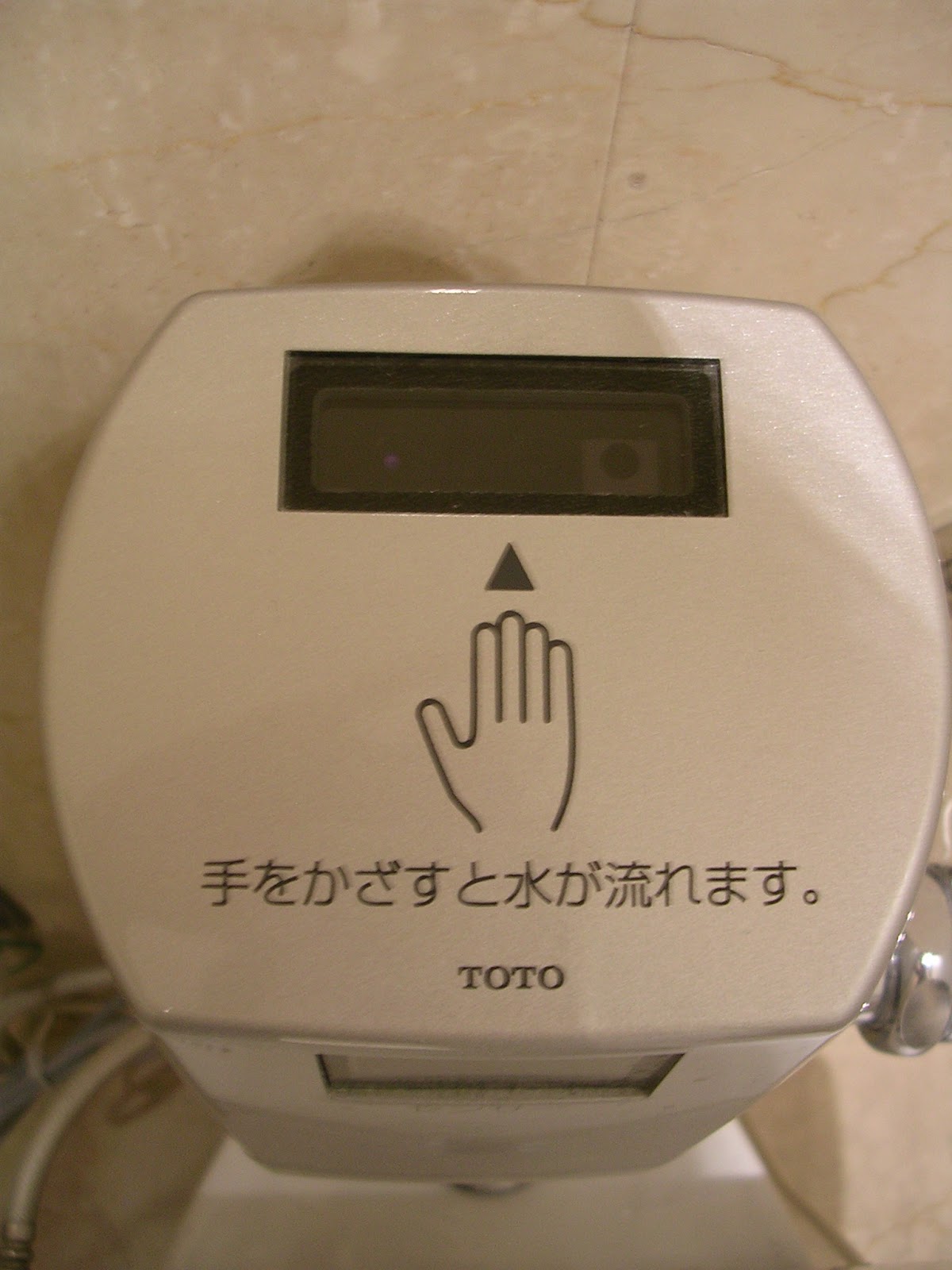
The photo below is a sensor-operation type. Place your palm over the sensor, and the toilet will flush.


Sometimes it is difficult to find a flush button, but don't panic. If you find a Washlet control panel installed on the wall, flush buttons must be somewhere on the panel, normally on its upper part. You can't see them from this angle, but...


Look! Can you see two “流す (to flush)” buttons? After peeing, press the right one marked with a Chinese character , which literally means "small" but in this case "urine".  When you need more water to clean the toilet, press the left one. In this photo nothing is written on this button, but you can often find a different character (lit. big) on it. I don't have to explain what it means, do I?


Automatic flush toilets are also becoming very common. When you leave the toilet, the toilet automatically flushes, but what should you do if you want to flush more than once? Look for a sensor panel like the one below, and press a manual operation button 手動ボタン(しゅどうボタン, shudo botan). In this photo it is the round white buttan with a red dot in the middle.


One more thing... it is safer NOT to touch anything red in the bathroom stall, whether a button or a cord. It is most probably an emergency button. Several years ago one of my former students (I'm a Japanese teacher) mistakenly pressed an emergency button at a railway station, trying to flush the toilet. Panicked, she ran away before station staff arrived to rescue her!

OK, here's today's useful expression: すみません、水が流れません。 Sumimasen, mizu ga nagaremasen. (=Excuse me, the toilet won't flush. )

I don't want to imagine the situation you have to use this phrase, though...

Apr 27, 2013

Eat a conger eel bowl. It is tasty!

Hi everyone!

The other day I had an あなご丼(anago-don) or literally meaning "conger eel bowl" for the first time in my life. I'm middle-aged, but luckily, I still have many things that remain undone!

Have you ever eaten anago (conger eel, or marine eel) anyway? If you have lived in Japan, I guess you have had a dish using the snake-like fish at least once or twice, because it is nothing unusual, nothing strange in East Asia.  In Japan, we commonly eat it as sushi or tempura, but seldom cook it at home, because professional skills are needed to cut it open remove the bones.

For someone who has never seen an anago, I found a nice photo in the website of the Tottori Fishermen's Association. Well, I personally don't find them particularly grotesque, but they don't look very appetizing either. 
 

Once cooked, the anago meat becomes very tender, not chewy at all. Its texture is similar to うなぎ (unagi, freshwater eels) but it tastes less fatty and more delicate. By the way, unagi and anago look so much alike that many Japanese cannot tell which is which. I'll explain how to distinguish them. The ones with a dotted line on the side of the body is anago. Well, I'm not sure if this info is important for you, though...

Anyway, here is the anago-don that I ate at an old traditional Japanese restaurant Enomoto(恵の本), near the famous Kawasaki Dashi (川崎大師) temple in Kawasaki City. The dish consists of a big bowl of steamed white rice and fillets of anago cooked in a soy-based sauce. It is served with a bowl of miso soup and some pickles. Tasty, but not cheap (2,000 yen).


If you don't feel like eating the conger eel bowl, you can eat something else at this restaurant. During the weekdays they offer more reasonably priced lunch menu (around 1,000 yen).

I'm not sure if this restaurant is worth going only for eating the anago bowl, but it would be one of the best places to have lunch before/after visiting Kawasaki Daishi temple. Enomoto is a very old restaurant with an over 300 years of history. The atmosphere is nice and the service is friendly.

Info about 恵の本 Enomoto: 
9-12 Taishi honcho, Kawasaki-ku, Kawasaki-shi
tel:044-288-2294, open 11 a.m.-10 p.m., closed Thursdays. 

Today's useful expressions:
(At the restaurant entrance) ふたり です。 Futari desu.  We are two people.
You can replace futari with san-nin (three people), yonin (four people) or gonin (five people).

穴子丼、ください。 Anago-don kudasai. I'll have a anago-don please.
お茶、ください。 Ocha kudasai. Can I have tea please? *Green tea is free at most Japanese restaurants.


Apr 25, 2013

Which tofu to choose? Cotton or silk?

Hi everyone!

Today's topic is tofu. I guess I don't have to explain what tofu is. But do you know the difference between "cotton tofu" and "silk tofu"? Or you haven't even noticed that there is a variety in tofu?

Well, this is a soft silken tofu, called 絹豆腐きぬどうふ、 kinu-dofu, silk tofu) or 絹ごし豆腐きぬごしどうふ、kinugoshi-dofu, literally meaning silk-filtered tofu) in Japanese. Can you see the hiragana “きぬ”?


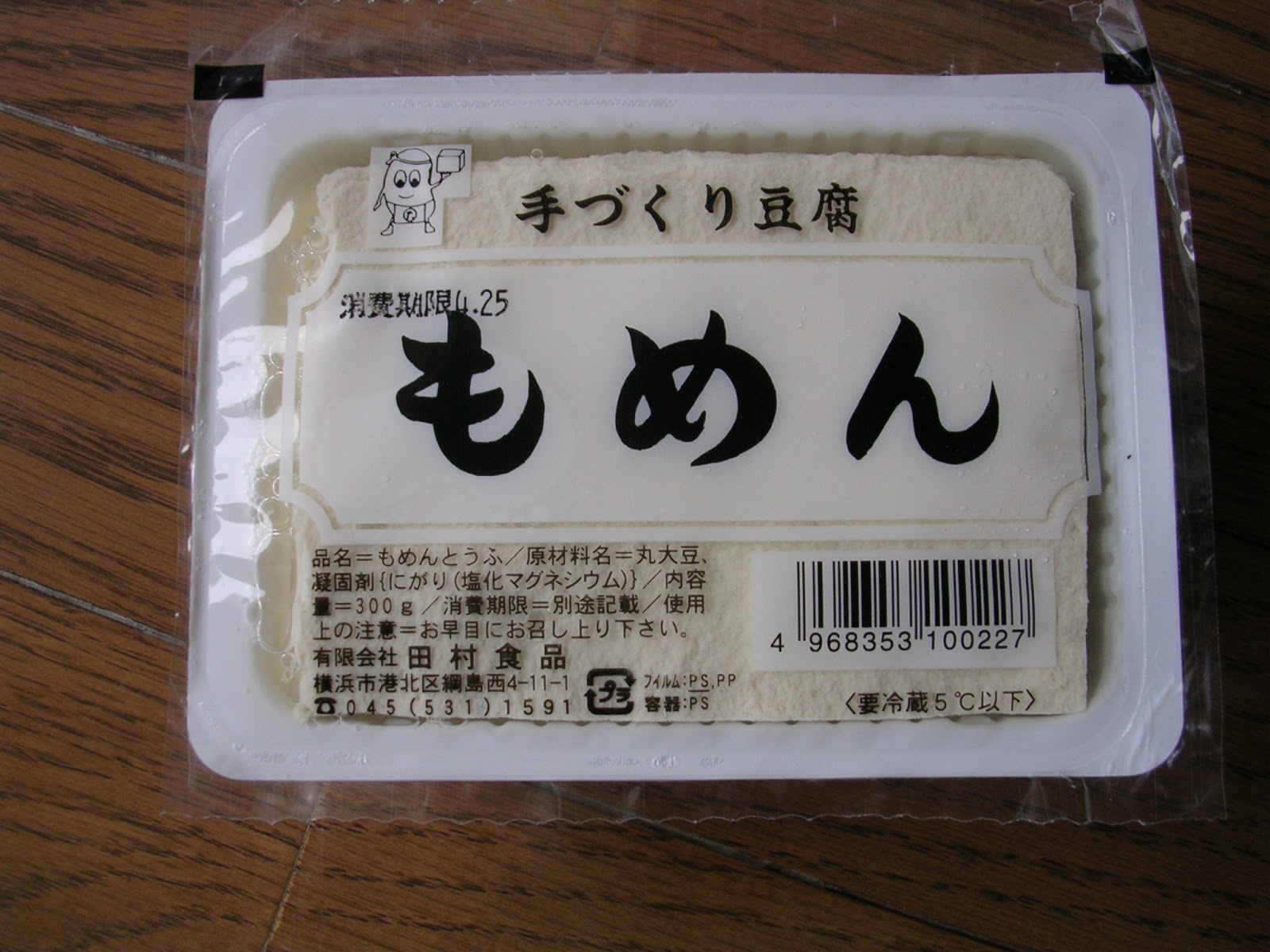
The name comes from the very soft, smooth texture. A silk filter is not used to strain soy milk in the manufacturing process, as some people misunderstand. Silken tofu is much more delicate than a firm tofu, also called 木綿豆腐もめんどうふ momen-dofu, or cotton tofu) .

Once again, this tofu has nothing to do with cotton. To make a cotton tofu, they first break coagulated soy milk, put it in a frame and press hard to drain. (A silken tofu is not drained. ) That's why this type of tofu is firm and can be picked up with chopsticks. Nutritionally, it contains more protein, calcium and iron than a silk tofu, and of course is higher in calories. 

Which to choose is up to your preference, but according to the Japan Tofu Association, a cotton tofu "is ideal for grilling, pan frying, simmering or deep frying," while a silken tofu should be eaten fresh as "hiya-yakko"  (a dish made with a chilled tofu and toppings, seasoned with soy sauce) so that you can enjoy its creamy texture.

I personally prefer a firm tofu and use it for hiya-yakko as well, though...
This is my hiya-yakko topped with finely chopped 万能ねぎ(banno negi, a type of spring onion similar to chives) and かつおぶし(katsuobushi, dry bonito flakes).   


Today's useful expression: これは もめんどうふ ですか?きぬごしですか?Kore wa momen-dofu desuka? Kinugoshi desuka?  Is this a firm tofu or a soft one?


Apr 24, 2013

The Washlet terms: how to use a modern bidet toilet

Hi everyone!

If you live in Japan, I guess you have already used Washlet, or a modern toilet seat with bidet functions, and know well how to use it.

So this post is for someone who just arrived in Japan or those planning to visit here.

"Washlet" is actually a brand name of Toto Ltd. but everyone commonly calls this type of toilets Washlet, like Band-aid or Stotch Tape, no matter which company produces it. 

I heard that a Washlet is installed in over 70 percent of Japanese households today. It is very common in public places as well, such as hotels, stations, restaurants and department stores.

OK, this is the one I'm using at home. It is not the latest model, but has all basic functions.


When you want to wash the anus, press the おしり (oshiri, or bottom) button, the second from the left. A nozzle comes out from underneath the toilet seat and squirts warm water. If girls would like to clean the different body part, press ビデ (bide, or bidet) button next to it, and the angle of the water jet will change.

To stop the water, press the left-most orange button marked  (stop). Don't forget. Never stand up before turning off the water, or the toilet floor gets wet.

After that you can dry the washed area with a blow dryer by pressing 乾燥(かんそう kanso, dry)button. However, I would recommend you the "conventional toilet paper method" because it takes long enough to dry the bottom completely and you might get cold.

You can adjust the strength of the water jet with the right-most 水勢 lever. Turn it clockwise (toward meaning strong) to have more powerful jet, and rotate in the opposite direction (toward or weak) when you want it softer. Be careful, if the jet is too strong, some water gets into your body and makes you jump!

Today's useful Japanese expression:
トイレ は どこ ですか。Toire wa doko desuka?  Where is the toilet (bath room)?
or  more politely
おてあらい は どちら ですか。 Otearai wa dochira desuka?
Oteawai literally means the place to wash the hands.  


Apr 23, 2013

Roll cakes (Swiss rolls) everywhere!

Hi everyone!

One of the sweets that can be found at any cake shops in Japan but hardly seen in Europe is a "roll cake" (ロールケーキ), Swiss roll in English. 

When I was living in Paris (2007-2010), I was always looking for the patisseries where I could buy these sponge cake rolls. Finally I discovered one, but the owner was Japanese and about a half of the customers were Japanese. I'm wondering if a Swiss roll has little appeal for French people for some reason?

In Japan a great variety of roll cakes is available. The flavors include vanilla, chocolate, strawberry, green tea, chestnut, etc. Coarsely chopped strawberries, mangoes and other fruits are sometimes added to the cream. The price varies depending on the size and ingredients, but it is usually between 1,000 yen to 1,500 yen a roll.

This is the one I recently ate. It s called Samurai Roll. Can you see the Chinese character (kanji) 侍 marked on the cake? It reads samurai (さむらい). Why samurai? Sorry, I have no idea, but it was super yummy with bitter caramel flavor.


I liked the package design too. A samurai is trying to cut a cake with a sward, saying "I have to slash this Samurai roll." (Sorry the photo is blurry.)


This is the result. Of course it is not the samurai but me who cut it.


This is another cake roll I bought the other day.  Isn't it pretty? It is a special spring item. 


Look! Strawberries inside! 


OK, today's useful expression is: ロールケーキはありますか? Roru-keki wa arimasuka? Do you have cake rolls here?