May 31, 2013

Mugicha (roasted barley tea) : something indispensable in summer!


When I was younger,  麦茶 (むぎちゃ、mugicha) or roasted barley tea, was always in the refrigerator of every Japanese household in summer.

Of course there were many kinds of cooling beverages back then, such as cokes, sodas and juices, but those were something we bought only occasionally, and it was normally mugicha that we gulped down every day, every time.

This non-sweetened, caffeine-free beverage goes well with any types of meals, and is suitable for people of all ages including small children.

In Japan barley tea is generally considered as a summer drink, but I drink it all year around (I heard it is normal in China), cold in summer and hot in other seasons, because I like the taste and also I can have it anytime of the day. I'm very sensitive to caffeine and caffeine drinks often make me difficult to fall asleep.

Tea is available in plastic bottles, but I'm making it at home. It is super easy, more eco-friendly and more economic. My mother boils roasted barley for several minutes to bring out the flavor and cool it down. I know this makes the tea taste better, but I don't to this. I'm using tea bags.


This is what I'm using: "香り薫るむぎ茶” (Kaori Kaoru Mugicha). Produced by Itoen, a major tea manufacturing company, containing 54 sachets,  it is less than 200 yen. I don't remember exactly how much it was, but I bought it at a bargain price, around 160 yen, which is cheaper than a tea bottle of 2 liters.


One tea bag is this size. You put it in 1-liter water and wait for two hours. That's all you have to do!


In two hours, simple filtered water turned into tasty barley tea! Too simple, right? You can take out the tea bag, but I leave it there. It won't become too strong.

Today's useful expression: つめたい むぎちゃは いかがですか?Tsumetai mugicha wa ikaga desuka?  (Would you like to have some cold barley tea?)

May 29, 2013

Rainy season has come in the Kanto area. Oh no! Too early!!


Today the Japan Meteorological Agency announced that the rainy season (it is called tsuyu) has started in the Kanto region, in Tokyo. Unbelievably early! According to the agency, this is the third earliest start in 62 years.

My friends and I were thinking of having a drink at an outdoor beer hall in Shibuya this weekend, but we probably have to change the plan.

Normally tsuyu begins in mid-June and lasts about a month. The weather forecast says that tsuyu of this year will end around July 20 as in other years. Ummm.... this means we'll have at least 10 more rainy days than usual.

If you are planning to visit Japan during the rainy season, don't forget to bring an umbrella! Though I know some of you don't like carrying it around, but if you are walking in the pouring rain without an umbrella, soaked to the skin, people might think you are weird and feel like staying away from you. (Be careful!)

Generally speaking, Japanese hate getting wet even a little bit, and many of them use an umbrella until it stops raining completely. Actually, so do I. When I go out without an umbrella and it suddenly starts to rain, I rush into a convenience store or a supermarket to buy one.


If you don't have an umbrella, why don't you buy a simple transparent plastic umbrella for 100 yen at Daiso or other all 100-yen store chains? You can throw it away or give it to someone before getting on the train.

But I want to strongly recommend women to get a 500-yen folding umbrellas that you can easily find at "all girly things" stores. They are compact, good quality, light-weight and come in a great variety of colors and patterns. They can become good souvenirs for you and your friends. The photo below is the one I got three years ago, and I'm still using it.


By the way, when you bring your wet umbrella into shops or buildings, you are required to pick one of the plastic bags found at the entrance and put the umbrella in it, to prevent the floor from becoming  wet and slippery, and throw it away in a garbage can when you leave.

You might think it is not eco-friendly (I think so too), but it is a kind of etiquette to do so. If it is against your policy, use your own water-proof bag.

Today's useful expression: ねふだを とってください。 Nefuda o totte kudasai.  (Please cut off the price tag.)


May 27, 2013

Geographic quiz of Japan


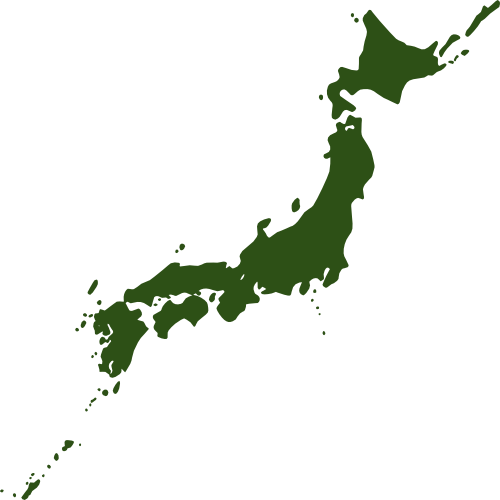
日本地図のシルエットのイラスト

Hi everyone! 

You might know that the economy of Japan is the third largest in the world after the U.S. and China, but what else do you know about Japan? 

I'll ask you some questions about geography of Japan. Even if you don't know anything, don't be embarrassed. Many of us Japanese don't know much about our own country anyway. (What a shame!)

Question 1: Japan is a bow-shaped island country, and four big islands comprises of 97 percent of the total land surface. Can you tell the names of all those islands?

Answer: Hokkaido, Honshu, Shikoku and Kyushu. For Japanese it is a too easy question.

Question 2: How many islands are there in Japan in total?  

Answer:  6,852 islands, of which 430 are inhabited. 

Question 3: Total land surface is about 378,000 sq.-km. What is the rank by area? 

Answer: Japan is 61, slightly bigger than Germany but smaller than the U.S. state of Montana.

Question 4: Why is Japan so densely populated?

Answer: Because 73 percent of the land is covered with mountains unsuitable for living and most of the population (about 128 million) concentrate on flat habitable zones, especially in big cities. 

Questions 5: Why are there so many earthquakes in Japan? 

Answer: Because Japan is located in the volcanic zone of the Pacific Ring of Fire. They say more than 90 percent of earthquakes that happen in the whole world occur in Japan. We have destructive quakes every century. Especially, the one that hit the North Kanto and Tohoku areas two years ago was shockingly devastating. 

Question 6: How many volcanos exist in Japan? 

Answer: 108 including Mt. Fuji. Don't forget, the famous Mt. Fuji is an active volcano!!

Frequent earthquakes and volcano eruptions sometimes make me feel like escaping from Japan and living somewhere else... but when I take a nice bath in onsen (hot spa) resorts, I easily forget the anxiety. How simple-minded I am!  


May 26, 2013

Let's go to see sumo!


Yesterday was the day I had been looking forward to. Yes, it was my sumo day!

There are six tournaments a year, and three of them are held in Tokyo, in January, May and September. The other three take place in Osaka (in March), Nagoya (July) and Fukuoka (November), and each lasts 15 days. 

When they have a tournament in Tokyo, I go to seethe sumo usually on the 14th day. 


When I was young, I was not interested in those fat naked wrestlers at all. I didn't understand why people of older generations were so excited about such an ugly sport. 

But now I'm a big fan of sumo. For me it is not just a sport, but a cultural entertainment that brings me back to the Edo Period. If you are aged over 25 and plan to visit Japan, check the sumo schedule here . I'm sure you'll like it too!


The Tokyo tournament is held at Kokugikan, one minute walk from JR Ryogoku Station.
Address: 1-3-28 Yokoami Sumida-ku, Tokyo
tel: 03-3623-5111

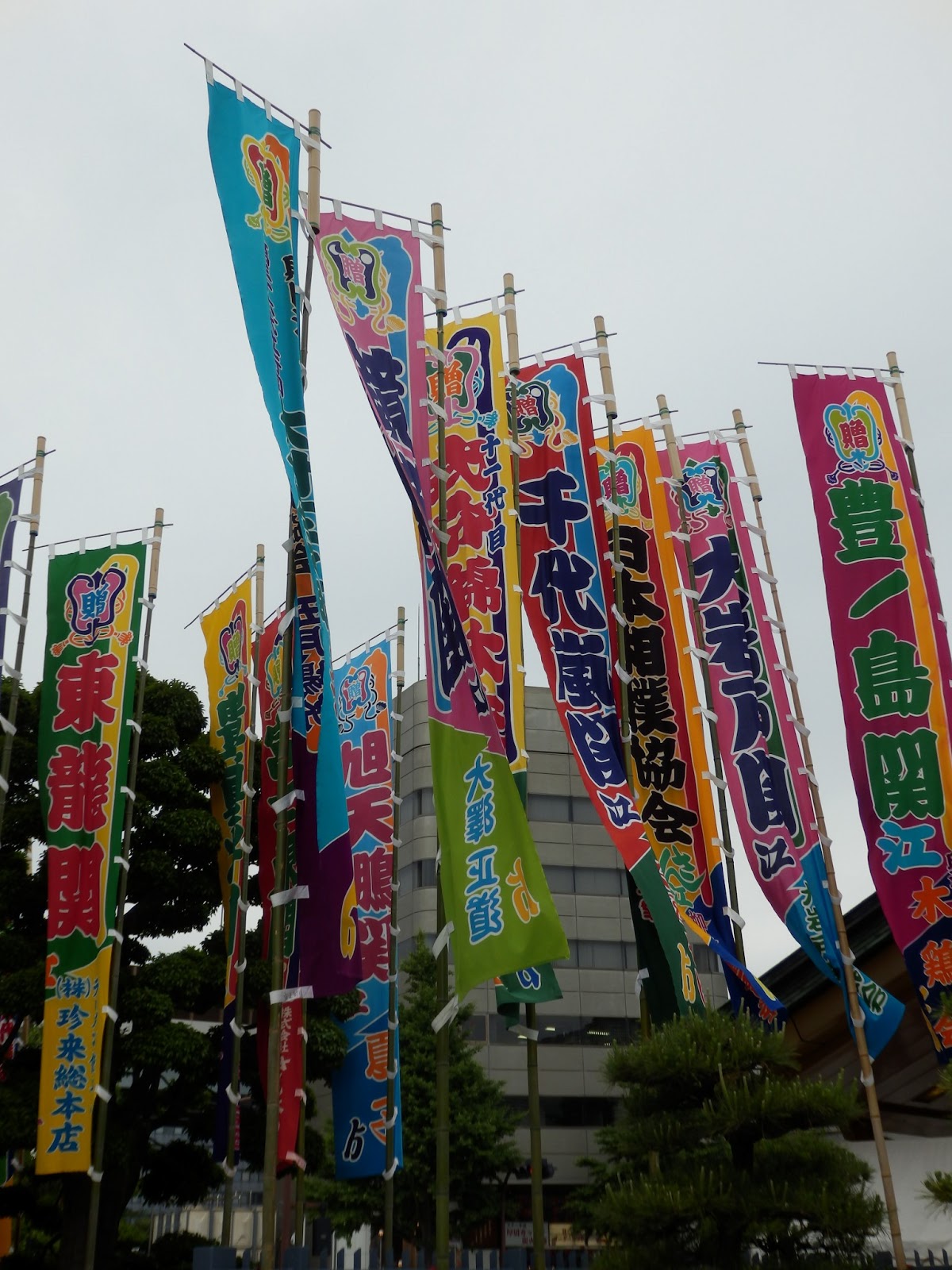
Colorful banner flags with the names of wrestlers at the gate create festive atmosphere. 


Ukiyoe  (woodblock prints) images depicting the sumo of the Edo Period on the outside walls. 


Inside there are shops selling foods, drinks and sumo-related goods. 


This is the dohyo ring. It is considered sacred and women are not allowed to step on it.  

The hall opens at 8 a.m. and the matches of low ranked wrestlers start around 8:30 a.m. but I always arrive there between 3 p.m. and 3:30 p.m., because strong and popular wrestlers appear after 4:10 p.m. 


Arriving at 4 p.m. is too late though. I don't want to miss the Makuuchi Doryo-iri ceremony (photo above) that starts at 3:45 p.m., and I need to buy something to drink or go to bathroom before that.

The higher-ranked wrestlers wearing the apron-like kesho-mawashi step on the dohyo (ring), being introduced one by one to the spectators. The kesho-mawashi, made with 100 percent silk and embroidered with silver and gold threads, is extraordinarily expensive, from 1 million yen to 20 million yen depending on the designs. They are normally presents from the wrestler's sponsors or the fan clubs. 


At 4 p.m. Yokozuna dohyo-iri starts. Yokozuna, or the highest-ranked wrestlers, performs "shiko" or the action of rising a leg high in the air to the side and stomping back on the ground.

Shiko is a basic training for sumo wrestler to strengthen their legs, but it is also performed as a ritual to get rid of evil spirits from the ground.

The wrestler shown in the photo above is Harumafuji. There are only two yokozuna at this moment, Hakuho and Harumafuji, and both of them are Mongolians.

Sumo is a Japanese national sport with a long history, but contrary to its exclusive image,  the sumo world is very open. If you are strong, you can climb the success ladder, regardless of your race and nationality.

For example, two out of four Ozeki, the second-highest rank wrestlers, are foreigners, one Mongolian and the other Bulgarian.


The photos of the tournament champions are displayed high around the hall. Looking at the photos I realized Japanese wrestlers have not won the championship for such a long time.

There was a match between Mongolian yokozuna Hakuho and Japanese ozeki  Kisenosato yesterday. Both of them had no lost matches until yesterday and many Japanese spectators wanted to see Kisenosato to beat the great yokozuna Hakuho.

When they appeared on the ring, the hall was shaken with the shouts and clapping of excitement. I love Hakuho, but this time I called out "KISENOSATO!!!!"


This is the photo of nervous-looking Kisenossato ready for the match.

The flags men in kimono are holding up represent the prize money from sponsors. One flag is 60,000 yen, of which the Japan Sumo Association takes 5,000 yen and the winner takes the rest. For this match there were 17 sponsoring flags.

The result? Unfortunately Kisenosato lost. It was a good match, but Hakuho was too strong.

Sorry there's no photo of the match. I was too excited to take photos. If you are interested,  please see this Youtube video.


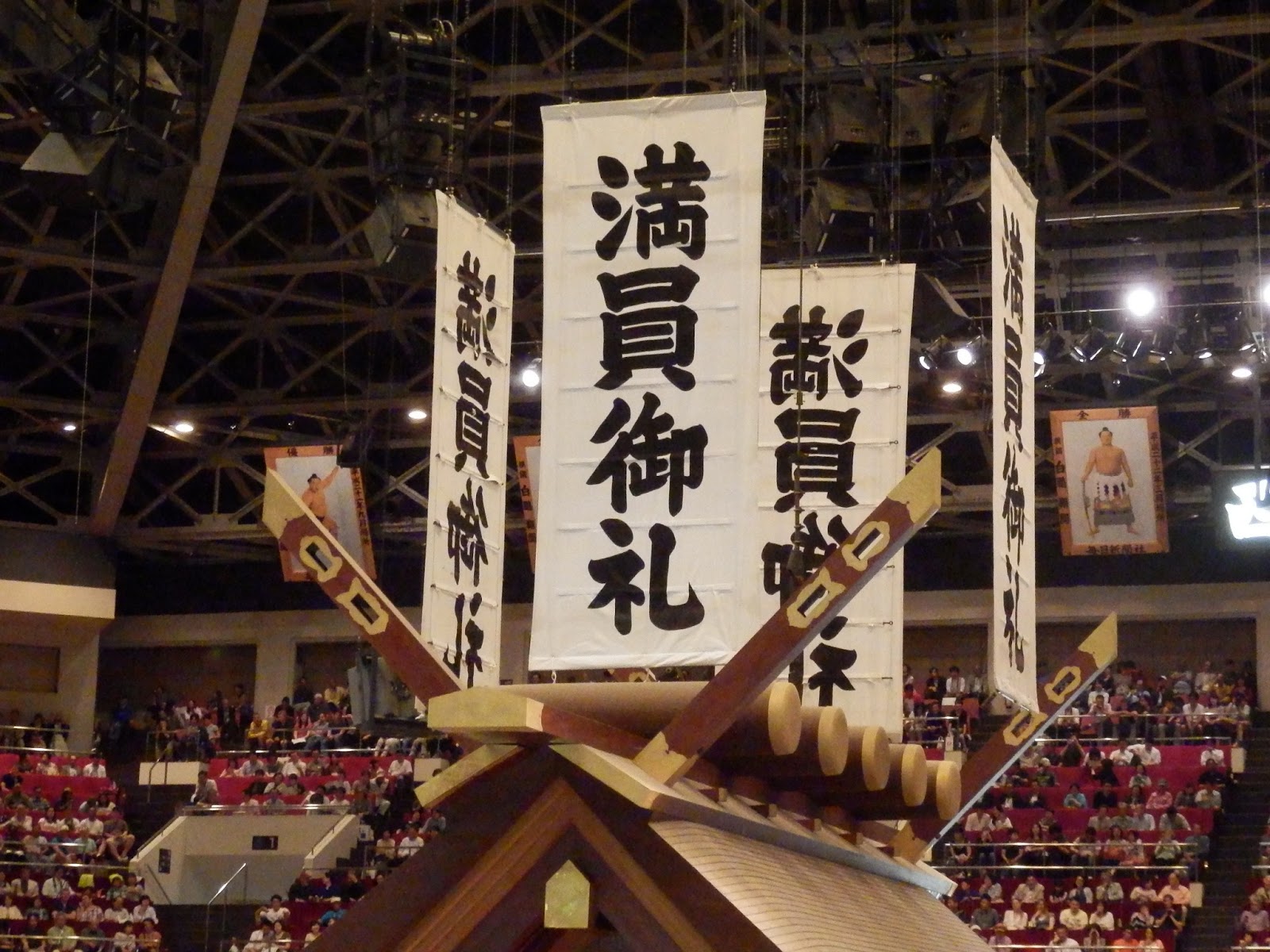
Usually you can buy the ticket of the day, but there were no tickets left when we arrived at the hall because of this match. The banners written "Thanks for the full house" were hanging from the ceiling.


Each tournament day ends with Yumitori-shiki, or a bow dance is performed by a sumo wrestler, usually not very famous.... 

Today's useful expression: とうじつけんは まだ ありますか。 Tojitsu-ken wa mada arimasuka?
(Do you still have tickets for today?) 

May 21, 2013

Japanese bread that I want to recommend ③: kare-pan (curry pain) & Melon-pan


If you like curry, I'm sure you'll love  カレーパン(curry pan)  as well (photo above).

Needless to say, "pan" comes from a Portuguese word for bread.  Curry-pan, pronounced karee-pan in Japanese, is a bun stuffed with curry paste. As it is deep-fried like a donut, it is sometimes called カレー・ド-ナッツ (karee-donattsu, curry donuts), but it rather reminds me of Russian snacks pirozhki.

As curry-pan uses no ingredients that are too "interesting"or "exotic" to non-Asians,  I think everyone can eat it without hesitation. If you are not allowed to eat pork for the religious reasons, however, you'd better check with someone at the bakery before buying one. You can ask this way:  ぶたにくは はいっていますか。 (Buta-niku wa haitte imasuka? Does this contain pork?)


We don't know exactly who "invented" the curry-pan, but it is generally believed that some bakers or restaurant cooks started making it in the early 20th century, when Japanese were becoming familiar with foreign food. Today it is available at almost any bakeries.


The photo above is a melon-pan, a different type of bread  that I want to show you.

Melon-pan is a sweet fluffy bun covered with crisp cookie dough. It is called this way because they say it looks like a melon. Ummm... I have never thought it looks like a melon, though.

What about taste? Does it taste like a melon? In recent years, some manufacturers are making melon-flavored melon-pan, but traditionally we add nothing that tastes or smells like a melon to the dough.

Melon pan was believed to have first created in Japan in the beginning of the 20th century, around the World War I. Ever since, they have been popular not only in Japan but also in Taiwan and China. Today, there are even stores specializing in melon-pan, where you can find many different flavors such as chocolate, caramel, orange and strawberry.

Ah, there's one thing I have to say. One melon-pan is about 500 kcal. If you don't want to get fat, don't eat it too much!

May 19, 2013

Sanja Matsuri is taking place this weekend!

Hi everyone! 

It is getting warmer and warmer in Japan. When it is sunny, we feel even hot! 

May is one of the most comfortable months here. If you are living abroad, I'd like to recommend you to visit Japan around this time of the year. Not too hot, not too cold, lots of sunny days. Although sakura (cherry blossoms) is over in Honshu island, you can see them in Hokkaido, and also we have many festivals! 

One of the most famous festivals in Tokyo is Sanja Matsuri, which is currently taking place in Asakusa. 

The highlight is today, but we went to see the festival yesterday to avoid too much crowd. 


Sanja Matsuri is annually held on the third weekend of May. Though considered one of the three representative Edo festivals, this festival used to have a rough and wild image with the involvement of local yakuza.  

Until several years ago, we had thought that half-naked tattooed men (usually yakuza) dancing and yelling on the mikoshi (portable shrines) was a norm, or rather considered as the essential part of the festival. 

We knew that the festival that attracts 1,5 million tourists was an important financial source of yakuza, but took it as a matter of course. According to the survey conducted in 2007 by the Metropolitan Police Department, about 70 percent of mikoshi carriers were related to yakuza.

Since 2008, however,  the act that carriers mount on mikoshi has been banned, and since 2012 the organizers has requested yakuza not to wear a hanten matsuri jacket with the name of their "kumi" (group or organization) printed on the back.

If you'd like to know what it was like before, take a look at the photo blog of an amateur photographer Edokko! Sanja Matsuri.

I saw many guys with arm tattoos showing from their half-sleeved hanten jacket yesterday, but you don't have to be scared. They are enjoying the festival and usually don't do any harm to tourists. 


Many hochin lanterns with the name of the sponsors, usually small shops and restaurants in the Asakusa district are put up around the Asakusa Shrine, next to the famous Sensoji Temple.


After the purification, more than 100 mikoshi from each district leaves the Asakusa Shrine one after another to stroll the Asakusa area.


Musicians playing the festival music are also townspeople. They include small children.

Looking at people in matsuri jackets, kimono and hakama (trouser-like men's kimono) walking around, you may feel as if you were back in the Edo Period.

Today's useful expression: おみこしは どこで みられますか。 O-mikoshi wa dokode miraremasuka? Where can we see the mikoshi (portable shrines?)

May 16, 2013

How to order sushi ②: tuna


Hi everyone!

Look at the photo above! The red sushi on the right is, needless to say, tuna, more exactly fatty tuna. Doesn't it look delicious? Well, it was VERY tasty.

Tuna is obviously the most popular sushi topping among Japanese. That's why I decided to pick up tuna as the first topic in this sushi series. 

Tuna fish is generally translated "maguro" in Japanese, but at sushi restaurants maguro usually means "lean tuna,"  and fatty portion of tuna belly is called by different name, "chu-toro" or "o-toro" depending on how fatty it is. (O-toro is fattier than chu-toro) .

When it comes to the price, the fattier, the more expensive. According to the price list of Bikkuri-zushi, a popular sushi chain in Tokyo and Kanagawa Prefecture, a maguro is 157 yen, a chu-toro is 262 yen and an o-toro is 420 yen.  (Be careful: sushi usually comes in two pieces, but this price is for only one piece.)

I know many foreigners prefer lean tuna, but you have to try chu-toro at least once. You'll be surprised at its soft melting texture!! I personally find chu-toro best among three kinds: maguro, chu-toro and o-toro. 

Today's useful expression: 中トロ、おねがいします Chu-toro onegaishimasu, Chu-toro please.  
You can replace chu-toro with whatever you'd like to eat.